In today’s fast-paced world, we often hear about the need for strong management. But what if the key to success isn’t better management, but rather effective leadership?
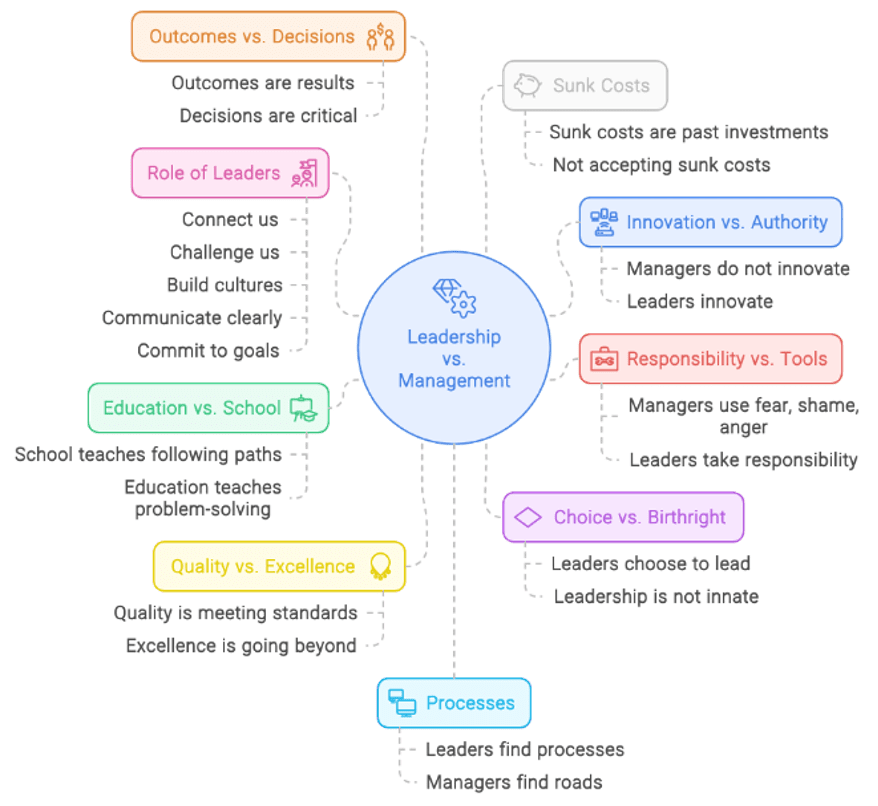
This idea was powerfully articulated by Seth Godin in his talk, “Leadership vs. Management: What it Means to Make a Difference,” (https://www.youtube.com/watch?v=qzoIAJYPQwo) where he emphasizes that leadership is fundamentally different from management:
1. Leadership vs. Management: A Fundamental Distinction
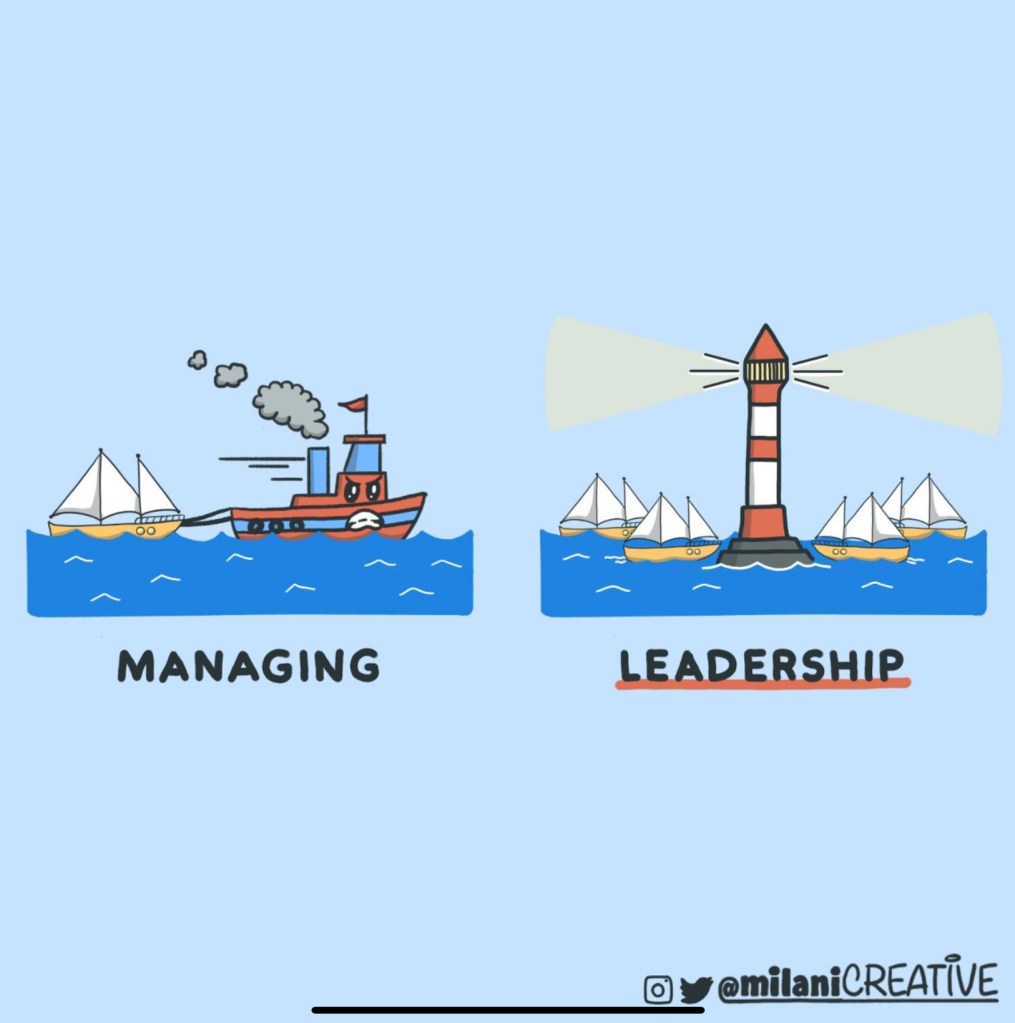
Managers focus on maintaining order and ensuring that systems run smoothly. They excel in environments where routines are essential and stability is valued. However, management alone struggles in times of change because its focus is often on preserving the status quo. As Godin argues, when the world changes—as it inevitably does—management falters because it is inherently resistant to change.
Leaders, on the other hand, thrive in uncertainty and are not just about maintaining the existing order. Leadership is about stepping into the unknown, making bold choices, and taking responsibility, even without explicit authority. Leaders inspire others to follow by example, not by coercion. In a rapidly changing world, it’s not management that will drive success, but leadership.
2. Responsibility vs. Authority
Godin makes a crucial distinction between responsibility and authority. Managers often wield authority; they have the power to enforce rules and ensure compliance. However, authority without responsibility can lead to a toxic work environment, where fear, shame, and anger are used as tools to drive performance.
In contrast, leaders may not always have formal authority, but they take responsibility. They are willing to step up, make tough decisions, and own the outcomes, regardless of their position within the hierarchy.
3. Education vs. Schooling
A compelling point Godin makes is the difference between education and schooling. Traditional schooling, he suggests, is designed to produce conformity—it teaches us to follow the rules and succeed within established frameworks. It was invented by industrialists.
However, real education should empower us to solve complex problems, innovate, and take responsibility. Leaders are not created by following the beaten path; they are forged by venturing into new territories and tackling challenges head-on.
4. Quality vs. Excellence
Godin introduces the idea of the «Quality Mistake,» highlighting how Quality in management terms often means meeting set standards and ensuring things work as they should. The tools managers use to get you to do what they want are: Fear, Shame and Anger.
But in leadership, the goal is Excellence—doing what is right, even if it’s not on the agenda. Excellence requires a willingness to challenge norms, innovate, and sometimes, fail in order to learn. It’s about caring deeply about the work and the people involved, going beyond the minimum required to create something truly remarkable.
Leadership is not something you are not born with, it is something you choose to do.
5. Decisions vs. Outcomes
Another critical insight is the difference between decisions and outcomes. Managers often focus on outcomes—measurable results that demonstrate efficiency and effectiveness. However, leaders understand that not all outcomes are within our control. Instead, they focus on making the right decisions, knowing that these decisions, rooted in values and vision, will lead to meaningful outcomes in the long run.
Choices and decisions are not the same. Choices don´t really matter, Decisions matter a lot!
6. Quitting: A Strategic Choice
One of the more counterintuitive points Godin makes is that sometimes, quitting is for winners. In the business world, we often view persistence as a virtue. However, knowing when to quit—when to pivot, change direction, or abandon a failing strategy—is a critical skill for leaders. It’s not about giving up; it’s about making strategic choices that align with long-term goals.
7. Building Processes, Not Just Roads
Lastly, Godin emphasizes that leaders focus on building processes, not just finding roads. A road is a one-time path, a process is repeatable and scalable. Leaders establish processes that empower others to act independently, innovate, and continue growing. This approach builds resilience within organizations, ensuring that they can adapt to change and thrive in the face of uncertainty.
Conclusion: The Call to Lead
In summary, Seth Godin’s talk is a powerful reminder that leadership is a choice, not a title. It’s about choosing to take responsibility, to innovate, and to care. In our rapidly changing world, we need leaders who can connect us, challenge us, and commit to a shared vision. Whether you’re leading a team, a company, or simply your own career, remember: Leadership is about making a difference.
What do you want to do?
#Leadership #Management #Innovation #Responsibility #SethGodin #BusinessStrategy #CareerDevelopment #ChangeManagement #SOEs #PublicAdministration
PS: Article researched and written with the assistance of AI
Descubre más desde Irrational Investors
Suscríbete y recibe las últimas entradas en tu correo electrónico.

 Irrational Investors