Introduction
Leadership is not just about holding a title or managing a team. It requires a complex blend of skills, empathy, and self-awareness that enable you to effectively guide, empower, and motivate your team. While some of these skills are well-known, others might surprise you. However, many who consider themselves effective leaders might not be as accomplished as they think.

We love the art from Roberto Ferraro!!!!
A Gallup study found that leaders account for at least 70% of employee engagement, which means that your levels of employee productivity, engagement, and enthusiasm at work depend significantly on your leadership.
This self-assessment will challenge your assumptions about your own leadership abilities through a series of probing «Really?» questions for each key skill. Take The (Really?) Leadership Test and see if your leadership measures up.
So, you think you’re a good leader? …Really?
Are you ready to put your leadership to the test and commit to continuous improvement?
…Really? 😉
How to Use This Assessment
- Read each question carefully and answer honestly.
- After each section, reflect on your responses and note areas for improvement.
- Use the scoring guide at the end to evaluate your overall performance.
- Review the provided action steps and resources for further development.
Let’s begin!
(You can find the complete article in pdf here: https://irrationalinvestors.com/wp-content/uploads/2024/12/the-really-leadership-test-2.pdf)
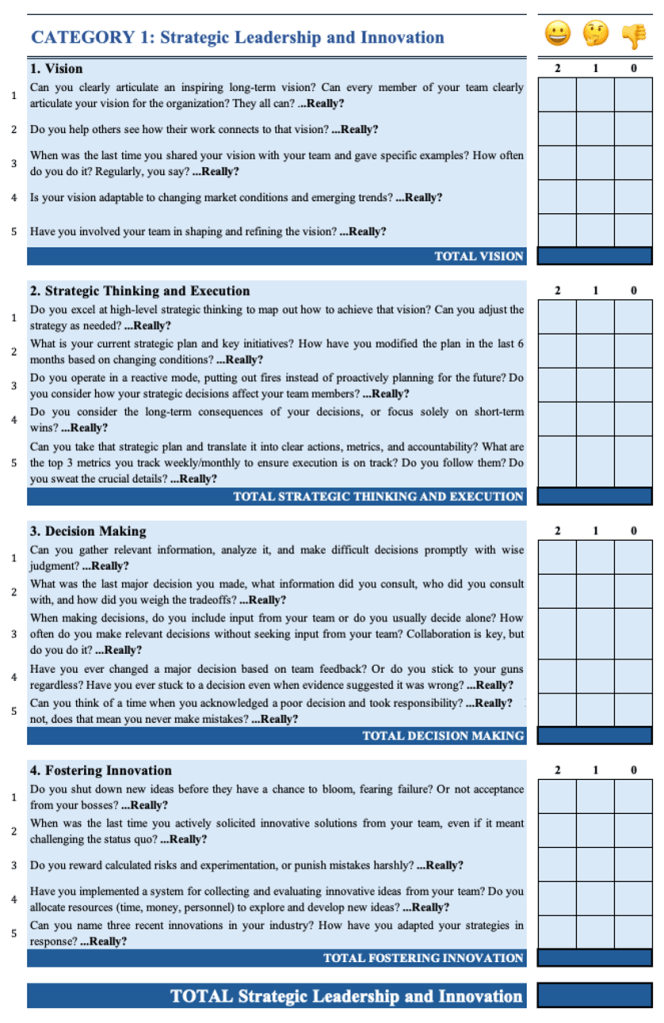
CATEGORY 1: Strategic Leadership and Innovation
1. Vision
Great leaders possess a clear and compelling vision, providing direction and purpose for their teams and organizations.
- Can you clearly articulate an inspiring long-term vision? Can every member of your team clearly articulate your vision for the organization? They all can? ...Really?
- Do you help others see how their work connects to that vision? …Really?
- When was the last time you shared your vision with your team and gave specific examples? How often do you do it? Regularly, you say? …Really?
- Is your vision adaptable to changing market conditions and emerging trends? …Really?
- Have you involved your team in shaping and refining the vision? …Really?
Improvement Tips:
- Regularly communicate your vision in team meetings.
- Create visual representations of your vision to reinforce understanding.
- Encourage team members to share how their roles contribute to the overall vision.
2. Strategic Thinking and Execution
Great leaders are strategic thinkers. They see the big picture, anticipate challenges, and plan for the future. But are you thinking strategically, or focused solely on the present?
- Do you excel at high-level strategic thinking to map out how to achieve that vision? Can you adjust the strategy as needed? …Really?
- What is your current strategic plan and key initiatives? How have you modified the plan in the last 6 months based on changing conditions? …Really?
- Do you operate in a reactive mode, putting out fires instead of proactively planning for the future? Do you consider how your strategic decisions affect your team members? …Really?
- Do you consider the long-term consequences of your decisions, or focus solely on short-term wins? …Really?
- Can you take that strategic plan and translate it into clear actions, metrics, and accountability? What are the top 3 metrics you track weekly/monthly to ensure execution is on track? Do you follow them? Do you sweat the crucial details? …Really?
Improvement Tips:
- Schedule regular strategic planning sessions with your team.
- Use tools like SWOT analysis to anticipate challenges.
- Set SMART (Specific, Measurable, Achievable, Relevant, Time-bound) goals to track progress.
3. Decision Making
Great leaders make sound and well-informed decisions, do you?
- Can you gather relevant information, analyze it, and make difficult decisions promptly with wise judgment? …Really?
- What was the last major decision you made, what information did you consult, who did you consult with, and how did you weigh the tradeoffs? …Really?
- When making decisions, do you include input from your team or do you usually decide alone? How often do you make relevant decisions without seeking input from your team? Collaboration is key, but do you do it? …Really?
- Have you ever changed a major decision based on team feedback? Or do you stick to your guns regardless? Have you ever stuck to a decision even when evidence suggested it was wrong? …Really?
- Can you think of a time when you acknowledged a poor decision and took responsibility? …Really? If not, does that mean you never make mistakes? …Really?
Improvement Tips:
- Involve key stakeholders in the decision-making process.
- Weigh pros and cons systematically.
- Be prepared to adjust decisions in light of new information.
4. Fostering Innovation
Great leaders create an environment where creativity thrives. They encourage new ideas and embrace calculated risks. But are you stifling innovation, or nurturing it?
- Do you shut down new ideas before they have a chance to bloom, fearing failure? Or not acceptance from your bosses? …Really?
- When was the last time you actively solicited innovative solutions from your team, even if it meant challenging the status quo? …Really?
- Do you reward calculated risks and experimentation, or punish mistakes harshly? …Really?
- Have you implemented a system for collecting and evaluating innovative ideas from your team? Do you allocate resources (time, money, personnel) to explore and develop new ideas? …Really?
- Can you name three recent innovations in your industry? How have you adapted your strategies in response? …Really?
Improvement Tips:
- Establish brainstorming sessions.
- Recognize and reward innovative thinking.
- Provide resources for experimentation.
Reflection: How well do you embody strategic leadership and foster innovation? What areas need improvement?
Action Steps:
- Schedule a team meeting to revisit and refine your organization’s vision.
- Implement a regular «innovation hour» where team members can pitch new ideas.
- Create a decision-making framework that includes seeking diverse perspectives.
CATEGORY 2: Personal Integrity and Ethics
5. Integrity
Great leaders uphold high ethical standards and live by them, even in adverse circumstances.
Do you serve your principles or just your bosses?
- Do you demonstrate high ethical standards through your actions? Do you build trust through authenticity and principled behavior? …Really?
- Can you give an example of a time when you took a professional or ethical risk because it was the right thing to do? …Really?
- Do you always follow through on your promises to your team? Without fail? Have you ever compromised your values for short-term gains? Never? …Really?
- Have you ever made a decision that benefited you personally but was not in the best interest of the team? Never? Can your team trust you to act in their best interests even when it is inconvenient for you? Always? …Really?
- When faced with an ethical dilemma, do you choose the easy way out or the right path? …Really?
Improvement Tips:
- Be consistent in your actions and decisions.
- Communicate your ethical standards clearly.
- Lead by example to inspire ethical behavior in others.
6. Accountability
Accountability is the willingness to take ownership of your actions and decisions. It is essential for building trust with your team and maintaining a positive work environment.
- Do you hold yourself and others accountable for delivering on stated goals and commitments? Do you hold yourself to the same standards as your team? Always? …Really?
- When was the last time you publicly admitted a mistake to your team? It happens often? …Really?
- Have you ever taken the fall for a team’s failure without shifting blame? Every time? How often? …Really?
- Can you recall a situation where you had to admit that you didn’t know the answer to a question or didn’t have all the information? How often does it happen? How did you handle it? …Really?
- Do you hold yourself accountable for failures? Have you ever shifted blame onto others to protect your image? …Really?
Improvement Tips:
- Set personal goals and share them with your team.
- Foster a culture where mistakes are viewed as learning opportunities.
- Recognize and rectify errors promptly.
7. Leading by Example
Actions speak louder than words. Leaders set the tone for their team, and their behavior has a ripple effect. But are you leading by example, or setting a bad one?
- Do you expect your team to put in extra hours/efforts while you don’t or you do not value them? …Really?
- Do you embody the values you preach to your team, or do you have a «do as I say, not as I do» mentality? Do you Walk the Talk? …Really?
- Have you ever complained about your boss or company culture in front of your team? …Really?
- Can you name three specific instances where you’ve gone above and beyond to set a positive example for your team? …Really?
- Do you maintain a positive attitude even in challenging situations? …Really?
Improvement Tips:
- Model the behavior you want to see in your team.
- Hold yourself accountable to the same standards.
- Maintain a positive attitude, especially during tough times.
8. Fairness and Equality
Great leaders ensure all employees feel valued by offering equal opportunities for recognition and advancement based on merit, to create a fair and inclusive work environment. An ethical leader should make decisions and assign responsibilities based on merit, fairness, and what is best for the organization and its stakeholders, not based on personal biases or favoritism. Ethical leaders ensure fair processes and outcomes.
- Do you treat all the members of your team equally, based on capacity, skills and merits? …Really?
- Do you allow your personal preferences to interfere with the way you make decisions and distribute responsibilities? Never? …Really?
- Do you actively seek out diverse perspectives when making important decisions? Do you make decisions and actions based on impartiality and equality? …Really?
- When was the last time you made a decision, and somebody from your team felt it wasn’t fair? How did you address the issue and ensure fairness? …Really?
- Have you implemented any policies or practices to promote diversity and inclusion in your team? …Really?
Improvement Tips:
- Implement transparent policies for promotions and rewards.
- Seek feedback to identify and address biases.
- Ensure diversity and inclusion in team dynamics.
Reflection: How well do you embody personal integrity and ethics in your leadership? Where can you improve?
Action Steps:
- Create a personal code of ethics and share it with your team.
- Implement a 360-degree feedback system to ensure accountability at all levels.
- Conduct an audit of your team’s diversity and create an action plan for improvement.

CATEGORY 3: Communication and Emotional Intelligence
9. Effective Communication – Transparency
Effective communication is the foundation of successful leadership. It involves not only conveying your message clearly but also actively listening to your team.
Great leaders communicate clearly, concisely, and consistently. They tailor their message to their audience and ensure everyone is on the same page. But are you communicating effectively, or leaving your team confused?
Great leaders keep lines of communication open, sharing necessary information to ensure everyone is aligned and can contribute effectively to the team´s goals. Do you? Not always?
- Can you clearly and persuasively communicate in writing, presentations, and conversations? Do you tailor your approach for the audience? …Really?
- When was the last team meeting you led where you didn’t do most of the talking? How did you engage others in the conversation? …Really?
- Do your team members feel free to express their opinions without any repercussions? …Really?
- If somebody asks your team about your qualities, is transparency going to be one of the answers? Do you lie to your team members? How often? You say never? …Really?
- How frequently do you give constructive feedback to your team? Regularly and effectively? Can you recall the last time you asked for feedback from your team members and actually took their suggestions into consideration? …Really?
Improvement Tips:
- Use clear and concise language to avoid misunderstandings.
- Encourage two-way communication by asking open-ended questions.
- Provide regular updates and be transparent about changes and decisions.
10. Active Listening
Great leaders don’t just hear; they actively listen. They create a space where their team feels valued and their voices are heard. But are you truly listening?
- Do you prioritize listening to and understanding your team members’ perspectives and concerns? Are you approachable? …Really?
- When was the last time a team member raised a concern in a meeting and you didn’t immediately react defensively? …Really?
- When was the last time you had a meeting with someone on your team just because they wanted to share their concerns or ideas, not related to any specific task or project? How long did they wait for that meeting? …Really?
- Can you recount the last three pieces of feedback you received from your team? Probably you can’t, were you really listening? …Really?
- Do your team meetings feel like a free-flowing conversation or a one-sided platform for your announcements? How often do you interrupt your team members during conversations or meetings? Never? …Really?
Improvement Tips:
- Practice active listening techniques, such as summarizing and reflecting back what you hear.
- Allocate time in meetings specifically for team input.
- Encourage an open-door policy for sharing ideas and concerns.
11. Emotional Intelligence
Emotional intelligence is crucial for building strong relationships with your team members and understanding their needs. It involves being empathetic, self-aware, and able to manage your own emotions.
- When was the last time you had a difficult conversation (for you) with a team member, and how did you handle it? Did you remain calm and composed, or did you let your emotions get the better of you? Were you fair? Did you apologize …Really?
- Can you think of a situation where you had to put yourself in someone else’s shoes and understand their perspective? How often does it happen? …Really?
- Have you ever dismissed someone’s emotional state as irrelevant to work? …Really?
- When was the last time you genuinely considered how your team members were feeling? What did you do about it? …Really?
- Can you name three specific strategies you use to manage your own emotions in high-stress situations? …Really?
12. Empathy
Empathy is the ability to understand and share the feelings of others. It is essential for building trust and fostering a positive work environment.
- When was the last time you checked in on a team member’s well-being without discussing work? Can’t remember? Is always the same team member …Really?
- Have you ever altered a project’s deadline because a team member had a personal crisis? Or is the deadline almost always non-negotiable? Is it the same for all the team members? …Really?
- How often do you genuinely consider the personal lives of your team members when assigning tasks? Often? …Really?
- Can you recall a situation where you had to make a tough decision that affected someone on your team? How did you handle the aftermath? Was it fair? …Really?
- Have you implemented any policies or practices that demonstrate empathy towards your team’s work-life balance? …Really?
Improvement Tips:
- Practice active empathy by being present and attentive.
- Show understanding and flexibility when personal issues arise.
- Ensure workloads are manageable and consider individual circumstances.
Reflection: How effective are your communication skills and emotional intelligence? Where can you improve?
Action Steps:
- Implement a regular «open door» policy where team members can discuss non-work-related concerns.
- Attend a workshop or course on improving emotional intelligence in leadership.
- Create a communication charter for your team that sets expectations for clear, respectful, and empathetic communication.

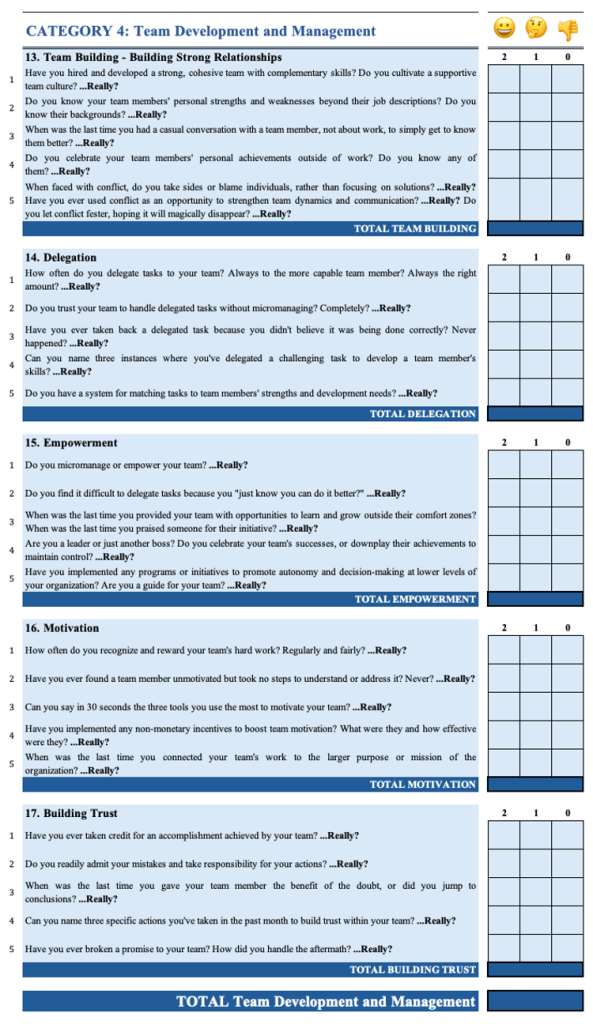
CATEGORY 4: Team Development and Management
13. Team Building – Building Strong Relationships
Leadership isn’t a solo act. Leaders build strong relationships with their team members, fostering a sense of belonging and connection. But, are you building relationships, or remaining isolated?
Conflicts are inevitable. Great leaders navigate disagreements constructively, finding solutions that Benefit the team
- Have you hired and developed a strong, cohesive team with complementary skills? Do you cultivate a supportive team culture? …Really?
- Do you know your team members’ personal strengths and weaknesses beyond their job descriptions? Do you know their backgrounds? …Really?
- When was the last time you had a casual conversation with a team member, not about work, to simply get to know them better? …Really?
- Do you celebrate your team members’ personal achievements outside of work? Do you know any of them? …Really?
- When faced with conflict, do you take sides or blame individuals, rather than focusing on solutions? …Really? Have you ever used conflict as an opportunity to strengthen team dynamics and communication? …Really? Do you let conflict fester, hoping it will magically disappear? …Really?
Improvement Tips:
- Organize team-building activities that allow members to connect personally.
- Implement regular one-on-one meetings to understand individual team members.
- Create a recognition program for both professional and personal achievements.
14. Delegation
Effective delegation is crucial for team development and efficient operations.
- How often do you delegate tasks to your team? Always to the more capable team member? Always the right amount? …Really?
- Do you trust your team to handle delegated tasks without micromanaging? Completely? …Really?
- Have you ever taken back a delegated task because you didn’t believe it was being done correctly? Never happened? …Really?
- Can you name three instances where you’ve delegated a challenging task to develop a team member’s skills? …Really?
- Do you have a system for matching tasks to team members’ strengths and development needs? …Really?
Improvement Tips:
- Match tasks with team members’ strengths.
- Provide clear instructions and expectations.
- Offer support but allow autonomy in task execution.
15. Empowerment
Great leaders don’t micromanage; they empower. They provide resources, support, and autonomy, allowing their team members to flourish.
But are you empowering, or just controlling?
- Do you micromanage or empower your team? …Really?
- Do you find it difficult to delegate tasks because you «just know you can do it better?» …Really?
- When was the last time you provided your team with opportunities to learn and grow outside their comfort zones? When was the last time you praised someone for their initiative? …Really?
- Are you a leader or just another boss? Do you celebrate your team’s successes, or downplay their achievements to maintain control? …Really?
- Have you implemented any programs or initiatives to promote autonomy and decision-making at lower levels of your organization? Are you a guide for your team? …Really?
Improvement Tips:
- Delegate meaningful tasks that challenge team members.
- Encourage decision-making at all levels.
- Support professional development initiatives.
16. Motivation
Keeping your team motivated is crucial for maintaining high performance and job satisfaction.
- How often do you recognize and reward your team’s hard work? Regularly and fairly? …Really?
- Have you ever found a team member unmotivated but took no steps to understand or address it? Never? …Really?
- Can you say in 30 seconds the three tools you use the most to motivate your team? …Really?
- Have you implemented any non-monetary incentives to boost team motivation? What were they and how effective were they? …Really?
- When was the last time you connected your team’s work to the larger purpose or mission of the organization? …Really?
Improvement Tips:
- Celebrate achievements publicly.
- Provide opportunities for professional growth.
- Align individual goals with team objectives.
17. Building Trust
“If you don’t believe in your team and/or your team doesn’t believe in you, … THERE IS NO TEAM!”
Trust is the bedrock of any successful team. A leader who is honest, transparent, and keeps their promises fosters a sense of security and psychological safety.
Are you building trust, or breaking it?
- Have you ever taken credit for an accomplishment achieved by your team? …Really?
- Do you readily admit your mistakes and take responsibility for your actions? …Really?
- When was the last time you gave your team member the benefit of the doubt, or did you jump to conclusions? …Really?
- Can you name three specific actions you’ve taken in the past month to build trust within your team? …Really?
- Have you ever broken a promise to your team? How did you handle the aftermath? …Really?
Improvement Tips:
- Be transparent in your actions and decisions.
- Foster an environment of psychological safety.
- Address trust issues promptly and constructively.
Reflection: How effective are you at developing and managing your team? Where can you improve?
Action Steps:
- Implement a regular one-on-one meeting schedule with each team member to discuss their goals and challenges.
- Create a delegation plan that matches tasks to team members’ strengths and development needs.
- Establish a recognition program that celebrates both individual and team achievements regularly.
CATEGORY 5: Adaptability and Continuous Learning
18. Adaptability, Flexibility, and Resilience
Flexibility is the ability to adapt to changing circumstances and priorities. It is vital for effective leadership, as it allows you to respond to unexpected challenges and opportunities.
The business world is constantly changing. Great leaders are adaptable and resilient, able to navigate change with a steady hand.
But, are you adaptable, or clinging to outdated methods? Are you a member of the status-quo team at work?
- How do you handle unexpected changes? With complete calm and flexibility every single time? …Really?
- Can you name a recent situation where you had to pivot your strategy on the fly? No hesitation? …Really?
- When was the last time you had to adjust your plans or priorities due to unforeseen circumstances? How did you handle the change? …Really?
- Do you resist change, fearing the unknown and clinging to the status quo? …Really?
- When faced with a setback, do you crumble under pressure, or use it as a learning experience to bounce back stronger? How do you react when a project takes an unexpected turn? Do you blame others or adapt? …Really?
Improvement Tips:
- Embrace change as an opportunity for growth.
- Develop contingency plans for potential challenges.
- Reflect on setbacks to identify lessons learned.
19. Learning Agility
«Not all readers are leaders, but all leaders are readers.»
- Are you constantly learning, evolving, and adapting? Can you anticipate and capitalize on emerging trends and opportunities? …Really?
- What is a new skill or domain you’ve invested significant effort in developing within the last 12 months? Is there any skill you need to acquire to better do your job and you are not learning? Very few? …Really?
- Are you able to recognize when your team members know more than you? Always? …Really?
- Have you attended any conferences, workshops, or training sessions to improve your leadership skills in the past year? How many books on leadership or your industry have you read in the past year? What did you learn and how have you applied it? …Really?
- Do you actively seek feedback on your leadership from peers, superiors, and subordinates? How often? …Really?
Improvement Tips:
- Allocate time for professional development.
- Encourage knowledge sharing within your team.
- Stay updated with industry trends and best practices.
20. Remote Leadership
In today’s increasingly digital world, the ability to lead remote or distributed teams is crucial.
- How effective are you at managing remote team members? …Really?
- Have you implemented any tools or processes specifically to improve communication and collaboration in a remote work environment? …Really?
- How do you ensure remote team members feel included and engaged? …Really?
- Can you name three strategies you use to maintain team cohesion in a virtual setting? …Really?
- How do you handle performance management for remote team members? …Really?
21. Crisis Management
Leaders must be prepared to guide their teams through unexpected challenges and crises.
- Do you have a crisis management plan in place? When was the last time you reviewed or updated it? …Really?
- How quickly can you mobilize your team to respond to an unexpected crisis? Have you ever practiced this? …Really?
- Can you recall a recent crisis where you had to make quick decisions under pressure? How did you handle it? …Really?
- How do you balance the need for swift action with the importance of gathering accurate information during a crisis? …Really?
- How do you communicate with stakeholders during a crisis to maintain trust and transparency? …Really?
Reflection: How adaptable are you as a leader? Are you committed to continuous learning and improvement? How prepared are you to lead in various challenging scenarios?
Action Steps:
- Set aside time each week for personal development and learning.
- Create a personal learning plan that addresses your leadership skill gaps.
- Conduct a crisis simulation exercise with your team to improve preparedness.
- Implement regular check-ins with remote team members to ensure they feel connected and supported.

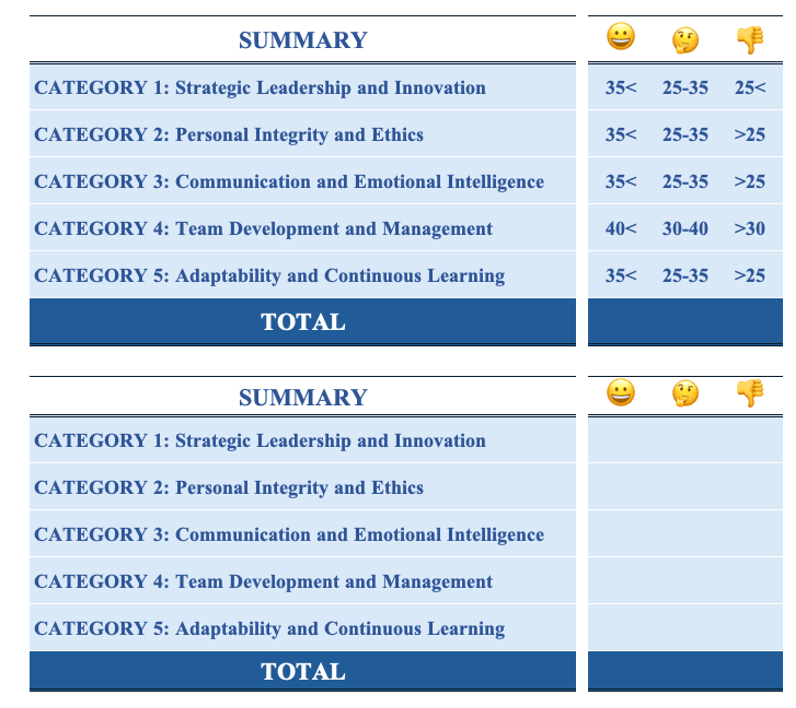
Scoring Guide

For each «Really?» question:
- If you confidently answered «Yes» or provided a strong example: 2 points
- If you hesitated or realized you have room for improvement: 1 point
- If you answered «No» or couldn’t provide an example: 0 points
Total your points for each category:
- 90-100% of possible points: Exceptional Leadership
- 75-89% of possible points: Strong Leadership
- 60-74% of possible points: Developing Leadership
- Below 60% of possible points: Significant Improvement Needed
Remember, this self-assessment is a tool for growth, not judgment. Use your results to identify areas for improvement and create an action plan for your leadership development.
Conclusion
While we may view ourselves as strong leaders, asking probing «Really?» questions can reveal blind spots and opportunities for growth. True leadership is an ongoing journey of humble self-awareness and continuous development of essential skills, including communication, emotional intelligence, empathy, flexibility, and accountability.
These skills are not just theoretical; they need to be practiced and demonstrated in real-life situations. Great leaders are not only self-aware but also committed to growth and the well-being of their team. The questions above are designed to challenge your leadership abilities and encourage you to reflect on your actions and decisions. If you find yourself hesitating or uncomfortable with any of these questions, it might be time to reassess your leadership approach.
Remember, leadership is not just about having a title; it’s about the impact you have on your team and the organization.
Next Steps
- Review your responses and identify your top 3 areas for improvement.
- Create a personal development plan addressing these areas.
- Seek feedback from your team, peers, and superiors on your leadership style.
- Consider working with a leadership coach or mentor to accelerate your growth.
- Commit to reassessing your leadership skills regularly using this test or similar tools.
Additional Resources
Remember, great leadership is a journey, not a destination. Keep learning, growing, and challenging yourself to be the best leader you can be.
- Books:
- «Leaders Eat Last» by Simon Sinek
- «Dare to Lead» by Brené Brown
- «Good to Great» by Jim Collins
- Online Courses:
- Leadership Skills on Coursera
- Organizational Leadership: Driving Culture and Performance on edX
- Podcasts:
- «Leadership and Loyalty» by Dov Baron
- «Coaching for Leaders» by Dave Stachowiak
- Websites:
References
- What Leaders Really Do (hbr.org)
- The Leadership Test (gallagher-westfall.com)
- Reference Check Questions for Leadership Positions (crosschq.com)
- Gallup: Why Great Managers Are So Rare
- Leadership Charter – Eurofins Scientific
- Center for Creative Leadership
- Harvard Business Review: The Future of Leadership Development
- Survey: 84 Percent of U.S. Workers Blame Bad Managers for Creating Unnecessary Stress (shrm.org)
- https://www.linkedin.com/feed/update/urn:li:activity:7205638611562614785?updateEntityUrn=urn%3Ali%3Afs_feedUpdate%3A%28V2%2Curn%3Ali%3Aactivity%3A7205638611562614785%29
- https://www.linkedin.com/posts/jakobbovin_my-manager-is-constantly-micro-managing-activity-7178712864973574144-SqpZ?utm_source=share&utm_medium=member_desktop
- https://www.linkedin.com/posts/jakobbovin_did-you-ever-work-with-someone-who-was-really-activity-7198264193609793538-LRVg?utm_source=share&utm_medium=member_desktop
- https://www.linkedin.com/posts/jakobbovin_imagine-youre-sitting-in-a-room-with-nine-activity-7194282695227592705-zJX2?utm_source=share&utm_medium=member_desktop
PS: Article researched and built with the assistance of AI
Descubre más desde Irrational Investors
Suscríbete y recibe las últimas entradas en tu correo electrónico.

 Irrational Investors