Is the distinction between speculation and investment truly valid, or is it merely a theoretical construct that has been consolidated throughout the history of financial markets? This article examines how, in today’s environment, marked by technological transformations, structural market changes, and a growing understanding of investor psychology, these categories have progressively blurred.
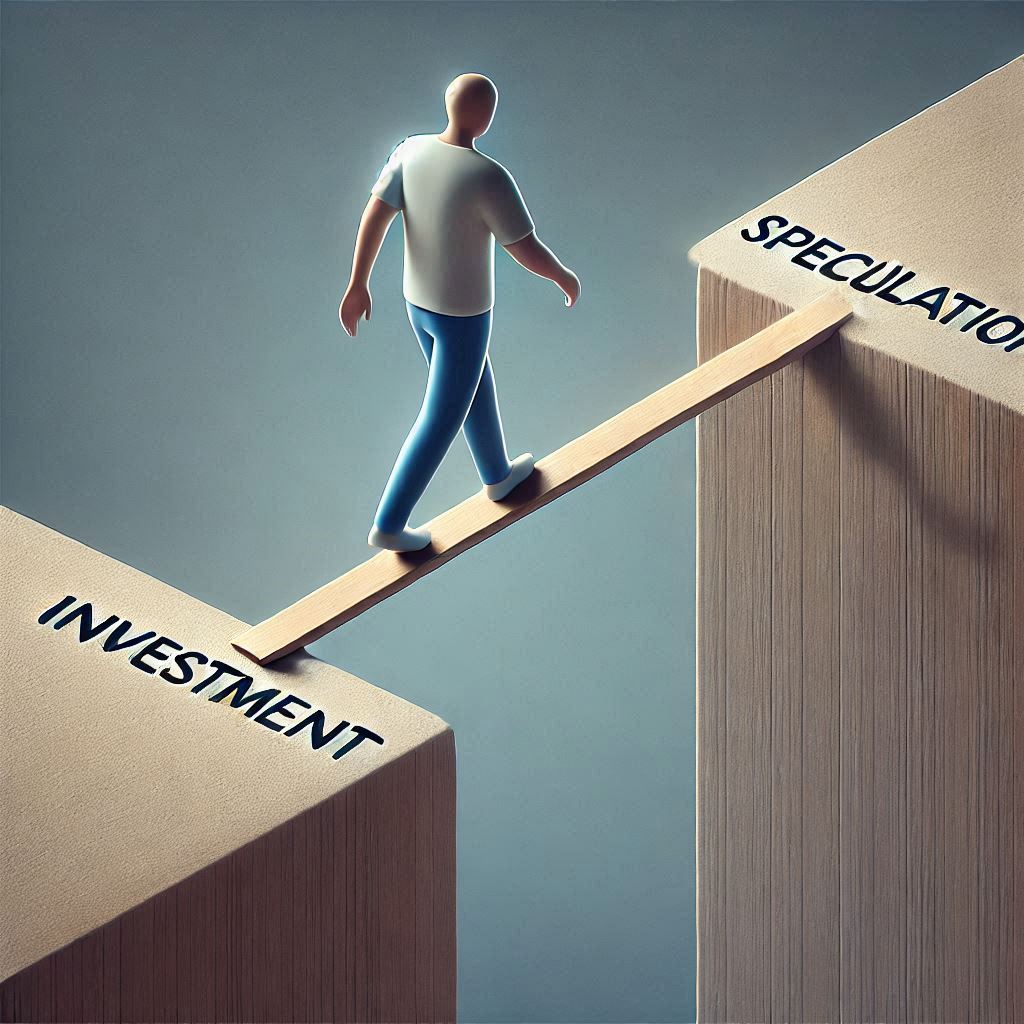
We will analyze the reasons behind this evolution, the practical implications for market participants, and the strategies needed to navigate this duality successfully.
What Separates an Investor from a Speculator?
Fred Schwed notes in Where Are the Customers’ Yachts?: “Speculation is an effort, probably unsuccessful, to turn a little money into a lot. Investment is an effort, which should be successful, to prevent a lot of money from becoming a little”
In contrast, Sir Ernest Cassell, a historic British banker, is often attributed with a quote that masterfully encapsulates the ambiguity: “When as a young and unknown man I started to be successful I was referred to as a gambler. My operations increased in scope and volume. Then I was known as a speculator. The sphere of my activities continued to expand and presently I was known as a banker. Actually, I had been doing the same thing all the time”.
Beyond the sarcasm, this quote reveals a structural reality: the perception of financial markets is deeply influenced by the size, circumstances, and narratives accompanying financial decisions.
The critical question is: what truly separates a speculator from an investor? Is it a matter of method/strategy, scale, or merely the lens through which we evaluate or perceive risk?
Historical Evolution of Investor Behavior
Investor behavior has changed significantly in recent decades. In the 1960s, institutional investors held stock positions for an average of eight years, reflecting a genuine long-term approach. However, by 2024, this average period has drastically decreased to just six months. This reflects a fundamental transformation in our relationship with financial markets, where globalization, technological disruption, and the relentless pursuit (and pressure) of quick returns have shortened investment horizons and increased trading frequency. This frenetic pace has replaced thoughtful analysis with a more reactive dynamic, exacerbating volatility.
“The line separating investment and speculation, which is never bright and clear, becomes blurred still further when most market participants have recently enjoyed triumphs. Nothing sedates rationality like large doses of effortless money.”
Warren Buffett
The Technological Revolution: Democratization and Disruption
Technology has reshaped financial markets by acting as a catalyst for both inclusion and complexity, altering the playing field:
- Automation of trading: More than 70% of stock trades in the U.S. are executed by algorithms, demonstrating how decisions once made by humans are now handled through automated models.
- Global access: Today, anyone with a smartphone can participate in international markets, breaking down historical entry barriers.
- Fractional investing: It is now possible to purchase fractions of shares, democratizing access to high-priced companies.
- Real-time information: While offering greater transparency, it also pressures investors to make immediate decisions, increasing the risk of errors.
However, this «universal» access does not necessarily guarantee better results. For example, high-frequency trading (HFT) has improved liquidity but also heightened volatility during critical moments. Moreover, retail investors, exposed to news filtered by algorithms, face the challenge of distinguishing between noise and relevant information.
This phenomenon is not exclusive to a single market. In Europe, investment holding periods have also declined; in Asia, retail investor participation has grown significantly; and in emerging markets, alternative trading systems have gained prominence. Faced with this new reality, regulatory authorities have proposed various measures to address associated risks, such as financial transaction taxes or corporate governance reforms aimed at fostering a more long-term approach. However, balancing these initiatives with the speed and complexity of globalized markets remains a significant challenge.
Psychology and Markets: The Battlefield
John Maynard Keynes understood that markets are not just about numbers but also collective emotions. Are we truly analyzing a company’s fundamentals, or are we merely following the narratives, guided or not, that dominate at the moment?
“Speculation leads you astray; it places emotions above analysis.”
John Bogle
Recent events seem to indicate the latter. During the COVID-19 pandemic, uncertainty reached unprecedented levels. The rise of cryptocurrencies challenged traditional valuation metrics, and meme stocks, such as GameStop, demonstrated how collective sentiment can overshadow rational analysis. Evidence from behavioral economics underscores how certain biases (loss aversion, herd behavior, among others) can distort even the most seemingly rational decisions.
Benjamin Graham, in one of his most famous works, The Intelligent Investor, defined investment as an operation which, upon thorough analysis, guarantees the safety of principal and an adequate return:
«An investment operation is one which, upon thorough analysis, promises safety of principal and a satisfactory return. Operations not meeting these requirements are speculative.»
However, in today’s market, Graham’s criteria is being tested by the following factors:
- Market speed: Decisions are made in seconds, not years.
- Information overload: Distinguishing between useful data and noise is an increasing challenge.
- Psychological pressure: Investors must contend with cognitive biases that complicate the discipline necessary for decision-making.
- Technological innovation: Algorithms can facilitate analysis but also become a double-edged sword.
- Globalization: Interconnected markets amplify the effects of local events worldwide.
In conclusion, the difference between investment and speculation does not lie solely in the assets themselves but in how they are managed and the intentions or objectives behind each financial decision. In today’s context, technology and globalization have redefined the boundary between the two, requiring a disciplined and adaptive approach to navigate the complexities of modern markets. Technology has redrawn the rules of the game, democratizing access but also multiplying challenges. The ability to balance modern tools, such as algorithms and real-time data, with solid financial principles and disciplined management will be key to thriving in an environment where traditional boundaries have disappeared and where emotional aspects can be both a strength and a weakness.
PS: Article researched and structured with the assistance of AI
Descubre más desde Irrational Investors
Suscríbete y recibe las últimas entradas en tu correo electrónico.

 Irrational Investors