In the world of corporate finance, companies have two primary ways of returning value to their shareholders: traditional dividend payments or buying back their own shares. Both approaches influence a company’s stock price, signal something about management’s perspective on future prospects, and carry various implications for investors and the broader market. But how do you decide which method is more suitable, and under what circumstances?
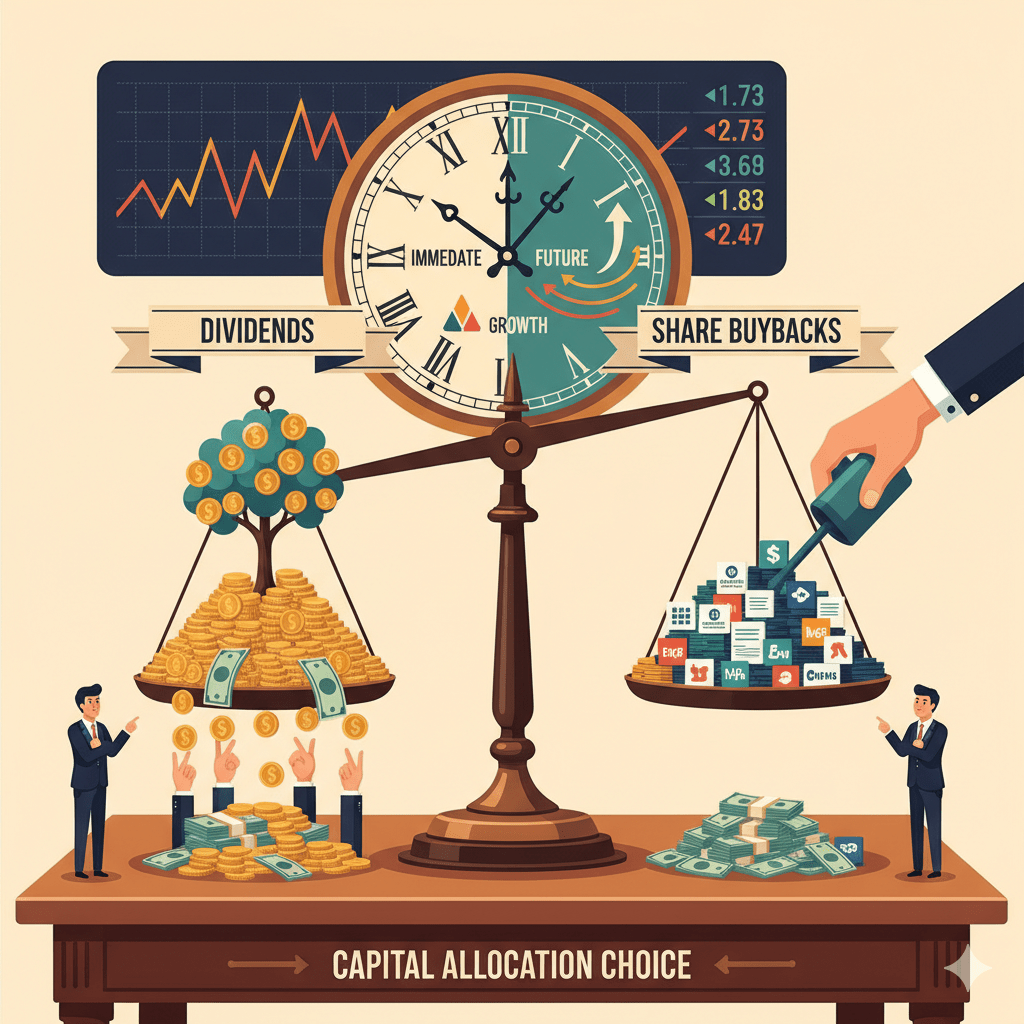
Understanding the Basics
- Dividends: A regular payment directly from the company’s earnings to shareholders. This method is usually chosen by mature companies with stable cash flows and limited growth opportunities. By committing to a steady dividend, management signals consistent profitability and reliability. Yet, once established, dividends become an expectation—if a firm cuts its dividend, the market often interprets it as a red flag.
- Share Buybacks: Instead of paying out cash directly, a company repurchases its own shares, reducing the number of shares outstanding. This typically boosts earnings per share (EPS) and can support or increase the stock price, especially if the shares are believed to be undervalued. Buybacks are more flexible than dividends because they can be initiated or paused at management’s discretion without the severe negative reaction that often accompanies a dividend cut.
When Are Dividends the Better Choice?
If your company is well-established, generating steady profits, and not facing any significant hurdles to growth, dividends can be a powerful way to attract income-focused investors. These investors appreciate the predictable cash flow and often view a solid dividend history as evidence of disciplined, shareholder-friendly management. Such a payout policy can also help stabilize the company’s investor base, reduce stock volatility, and create a loyal following.
When Are Buybacks the Stronger Move?
For firms that believe their shares are undervalued or that have just completed a cycle of major investments and now find themselves with surplus cash, buybacks can be a strategic tool. By purchasing shares at attractive prices, companies can effectively invest in themselves, driving EPS upward and often boosting the stock’s market perception. Moreover, buybacks let shareholders control the timing of their tax events because gains are only realized when they choose to sell. This flexibility is particularly appealing for investors who prefer capital appreciation over immediate taxable income.
When Not to Use …
When not to use (or raise) dividends: Regular dividends are sticky, so a company must only use them when through-cycle free cash flow comfortably covers them after funding maintenance capex, working capital, and prudent balance-sheet buffers. If the company´s incremental ROIC materially exceeds the shareholders’ after-tax cash yield, reinvestment dominates payouts. Likewise, avoid companies using/increasing dividends in early-stage, cyclical, or project-financed businesses where cash flows are volatile; the reputational and valuation damage from a future cut can exceed any signaling benefit today.
When not to use buybacks: Repurchases only create value when shares trade at a discount to conservative intrinsic value; above fair value they transfer wealth from continuing to selling share holders. Avoid companies with debt-funded buybacks that push net leverage beyond board-approved bands or shrink liquidity cushions it´ll need in a downturn; repurchases should not crowd out positive-NPV investments, pension funding, or essential risk mitigation. Be wary of programmatic, price-insensitive buybacks in thinly traded names (market impact), or of using repurchases mainly to mask dilution or “manufacture” EPS growth without improving unit economics.
So? Pros and Cons at a Glance
- Dividends:
- Pros: Stable, predictable income; strong signal of financial health; appeals to long-term income investors.
- Cons: Less flexible; creates recurring tax events for shareholders; cutting dividends sends a negative market signal.
- Buybacks:
- Pros: Flexible timing; can signal undervaluation; potentially more tax-efficient for investors; improves per-share metrics.
- Cons: Not guaranteed to add value if shares are not truly undervalued; may draw scrutiny for short-termism or management self-interest; some regulators and policymakers question their broader economic impact.

Conclusion
There is no one-size-fits-all answer to the dividends-versus-buybacks debate. The choice depends on company maturity, cash flow stability, valuation perspectives, and shareholder preferences. Mature companies may lean toward dividends to cultivate a stable, income-oriented investor base, whereas more flexible or opportunistic firms may prefer buybacks to capitalize on market mispricing or maintain strategic agility.
Ultimately, the best approach combines thoughtful financial analysis with transparent communication. Shareholders deserve to understand management’s reasoning, and companies must regularly reassess whether their chosen distribution policy still aligns with their strategic objectives and market conditions.
Quotes
Dividends
- “A stock is worth the present value of all the dividends ever to be paid upon it, no more, no less.” — John Burr Williams, 1938. ivey.uwo.ca
- “One of the most persuasive tests of high quality is an uninterrupted record of dividend payments for the last 20 years or more.” — Benjamin Graham, The Intelligent Investor.
- “We documented the overwhelming and worldwide importance of dividends to the long-term real returns on common stocks.” — Dimson, Marsh & Staunton, Global Investment Returns Yearbook. theonliner.ch
- “…the value of the firm is independent of the current dividend decision.” — Modigliani & Miller, 1961.
Share buybacks
- “Continuing shareholders are hurt unless shares are purchased below intrinsic value.” — Warren Buffett, Berkshire letter (2011).
- “The first law of capital allocation—what is smart at one price is dumb at another.” — Warren Buffett, Berkshire letter (2011).
- “When you are told that all repurchases are harmful… you are listening to either an economic illiterate or a silver-tongued demagogue.” — Warren Buffett, Berkshire letter (2022). berkshirehathaway.com
- “Golden rule: Use repurchases when a stock is cheap and issuing shares when the stock is dear.” — Michael Mauboussin, “Share Repurchases from All Angles.”
- “Buybacks, in effect, are flexible dividends.” — Aswath Damodaran, 2025 update.aswathdamodaran.blogspot.com
- “We much prefer to use our capital to grow than to buy back stock.” — Jamie Dimon, JPMorgan CEO letter (2017). JPMorgan Chase
- “Buying back stock should only be considered when we either cannot invest… or when we are generating excess, unusable capital.” — Jamie Dimon, 2017. JPMorgan Chase
- “Buybacks are divisive—they divide people who do understand finance from people who don’t.” — Kenneth French, Fama-French (as quoted by Morgan Stanley). Morgan Stanley
P.S: Article researched and built with the assistance of AI
Disclaimer:
We have no positions in any of the securities mentioned and do not plan to initiate any positions within the next 72 hours.
We wrote this article ourselves, and it reflects our own opinions. We did not receive compensation for it. We have no business relationship with any company whose stock is mentioned in this article.
The views contained in this document are for informational and educational purposes only and should not be construed as a recommendation to buy or sell any of the securities mentioned, or as a solicitation of transactions or clients. The past performance of the companies discussed may not continue, and they may not achieve the earnings growth anticipated. The information contained herein is believed to be appropriate; however, under no circumstances should any person act solely based on the information provided. We do not recommend that anyone act on any investment information without first consulting an investment advisor regarding the suitability of such investments for their specific situation.
Descubre más desde Irrational Investors
Suscríbete y recibe las últimas entradas en tu correo electrónico.

 Irrational Investors