AI WORKS, THE TECHNOLOGY IS NOT THE BOTTLENECK!
Every quarter, a new wave of enterprise AI announcements floods LinkedIn with new pilots. new partnerships, new apps, new transformative initiatives backed by freshly allocated budgets and breathless internal memos. And every quarter, the data tells the same brutal truth; the vast majority of these projects will fail. Not because the models do not work or because the algorithms are flawed, but because the people running these organizations have not done the homework.
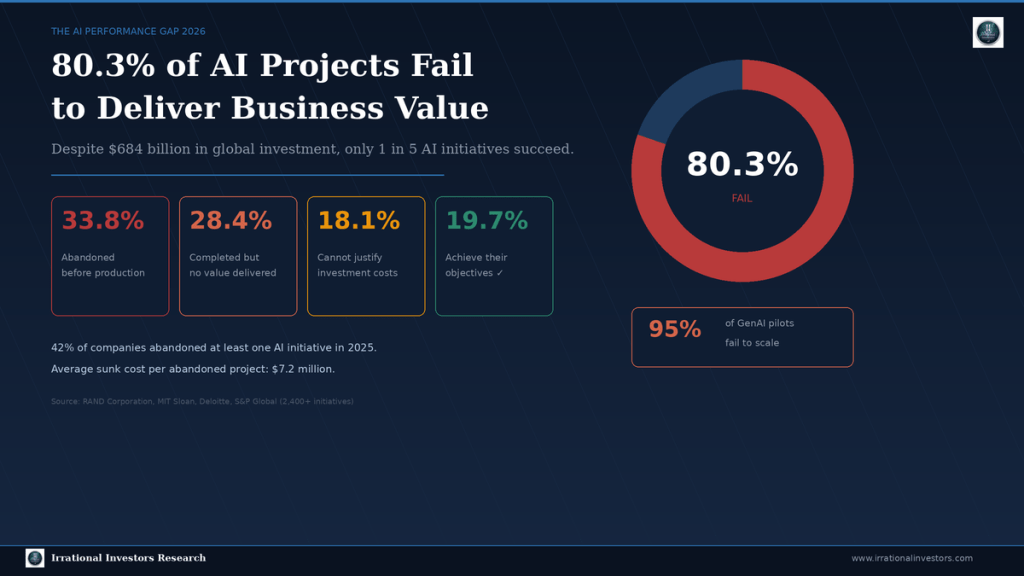
A comprehensive statistical analysis published by Pertama Partners, drawing on data from RAND Corporation, MIT Sloan, McKinsey, Deloitte, Gartner, and over 2.400 enterprise AI initiatives, makes the case with uncomfortable clarity, 80,3% of AI projects fail to deliver their intended business value. Of those failures, 33.8% are abandoned before production, 28,4% reach completion but don’t deliver any value, and 18.1% deliver marginal output that cannot justify the cost. Only 19,7% achieve their objectives.
The generative AI picture is even worst. MIT Sloan found that 95% of GenAI pilots fail to scale to production, with cost overruns averaging 380% at production scale. The median time from pilot approval to production shutdown is fourteen months, long enough to consume serious money, short enough to deliver almost nothing lasting.
The Numbers That Should Keep Every Board Awake
In 2025, global enterprises invested an estimated $684 billion in AI initiatives. By year-end, over $547 billion of that investment had failed to deliver the intended business value. No rounding errors, just systemic capital destruction.
Overall Failure Rates
According to RAND Corporation’s 2025 analysis, 80,3% of AI projects fail to deliver their intended business value:

Source: RAND Corporation, 2025
The abandonment trend is accelerating. According to Deloitte, 42% of companies abandoned at least one AI initiative in 2025, with an average sunk cost of $7,2 million per abandoned project. Large enterprises with more than 10,000 employees abandoned an average of 2,3 initiatives each.
The Generative AI Paradox
The generative AI hype cycle has produced what may be the most expensive «pilot tonowhere» pipeline in corporate history.
95% of GenAI pilots fail to scale to production deployment (MIT Sloan, 2025). Infrastructure costs run three to five times initial projections at production scale. Cost overruns average 380%.
“The 95% GenAI pilot failure rate does not mean generative AI lacks value. It means that most organizations underestimate the infrastructure, data governance, and engineering rigor required to move from impressive demos to reliable production systems.”
Pertama Partners Analysis
It Is Not the Algorithms. It Is the C-Suite.
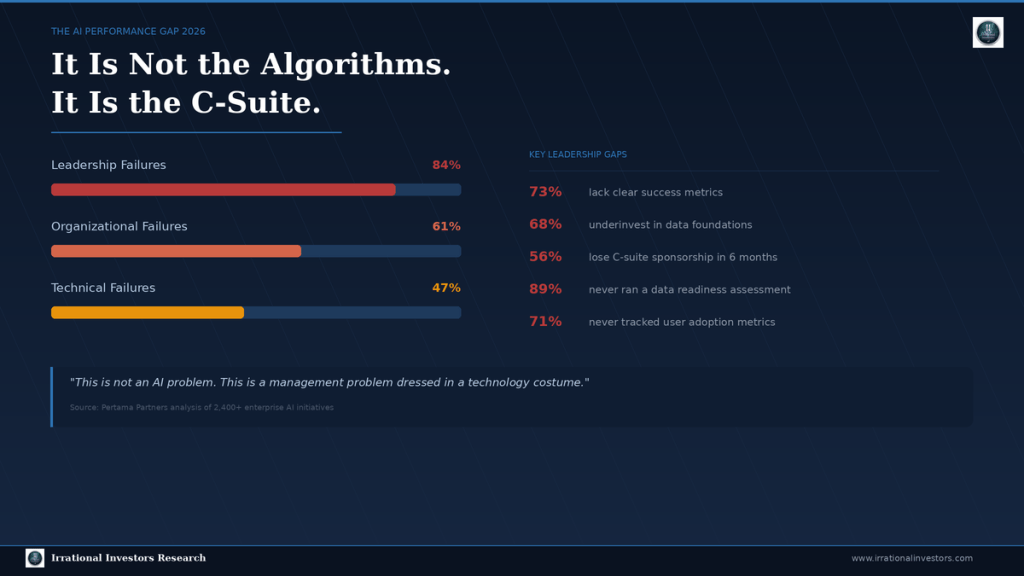
When we look at the breakdown of why these projects fail, the data reveals three distinct categories: leadership, organizational and technical failures. The instinct in most boardrooms is to blame the technology, but the data says quite the opposite.

Source: Pertama Partners analysis of 2.400+ enterprise AI initiatives
Leadership Failures (84%)
Leadership failures are the dominant cause of AI project failure, present in 84% of all failed initiatives. The most common leadership failures are:
- 73% of failed projects lack executive alignment on what success even looks like (no quantified business objectives and no agreed metrics). Projects launched while stakeholders still disagree on what the initiative should achieve, then measured, if at all, by criteria invented retroactively, on average, eight months after approval. This is not an AI problem, clearly, this is a «management problem dressed in a technology costume».
- The second failure pattern is data governance, or rather, the absence of it. 68% of failed projects underinvest in data foundations, discovering quality issues an average of 5,2 months into development. By then, remediation costs average 2,8 times the original project budget. And 89% of failed projects never conducted a formal data readiness assessment before committing resources. They jumped straight from «AI is exciting» to «let’s build something,» without ever asking the foundational question: do we have the data to make this work?
- The third pattern is perhaps the most revealing. In 61% of failed initiatives, organizations treated AI as an IT project rather than what it actually is, a business transformation that changes how people work, decide, and create value. Change management received less than 15% of the total project budget. Business stakeholders were not meaningfully engaged until an average of seven months into the project. User adoption metrics were never tracked in 71% of cases.
- And then there is sponsorship. 56% of AI projects lose active C-suite sponsorship within six months. Executive review frequency drops 73% between months one and six. The impact is devastating: projects with sustained CEO involvement achieve a 68% success rate, while projects that lose sponsorship succeed just 11% of the time.
Technical Failures (47%)
Technical challenges contribute to 47% of failures, but rarely in isolation. Data quality is the most common technical barrier: 71% of failed projects encounter significant data quality issues, with data preparation consuming an average of 61% of the project timeline. Integration complexity compounds the problem: 58% of projects face integration challenges that exceed planning estimates, with actual timelines averaging 2,4 times the original estimate.
Organizational Failures (61%)
Organizational resistance proves to be the most stubborn category. User adoption rates fall below 40% in the first six months for 62% of implementations. Business users frequently revert to manual processes despite AI availability, 79% of implementations lack adoption incentives, and 84% have no consequences for ignoring AI recommendations. The technology can be flawless and still fail if nobody uses it.
The Industry Pecking Order of Failure
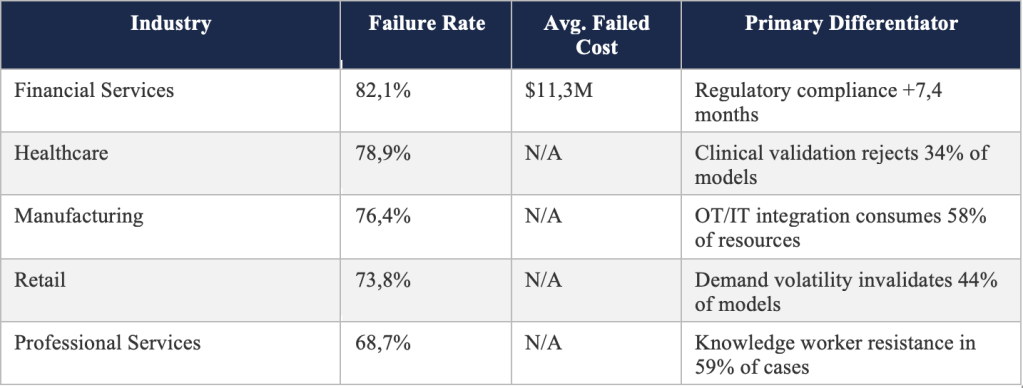
Failure rates vary significantly by sector; the more heavily regulated the industry, the higher the failure rate. But regulation is not the root cause, it is the amplifier. The same leadership and organizational failures exist across all sectors. Regulation just makes those foundational weaknesses more expensive and more visible, faster.
Source: Pertama Partners compilation from RAND, McKinsey, Deloitte, Gartner
The Economics of Failure (and the Economics of Getting It Right)
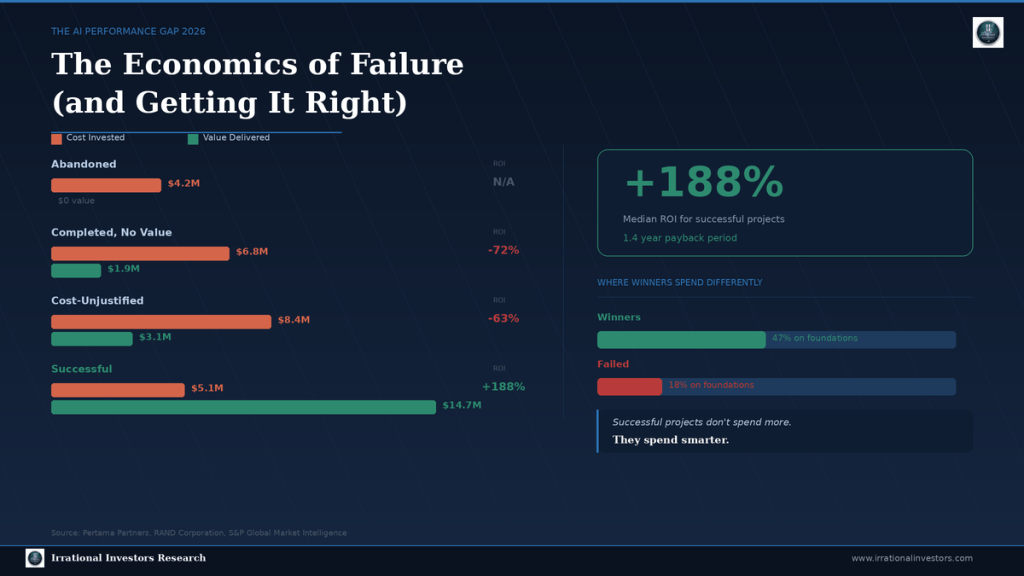
The financial analysis is where the data becomes genuinely compelling for anyone thinking about capital allocation. Failed projects cost between $4,2 million and $8,4 million, depending on the stage of failure. The most insidious category, projects that technically deliver something but cannot justify their costs, averages $8,4 million in spend against $3,1 million in value, with a payback period of 7,8 years against a typical two-year threshold. These are the hardest to kill because they show just enough results to justify their continued existence while quietly bleeding capital.

Source: Pertama Partners, RAND Corporation, S&P Global Market Intelligence
Successful projects do not spend more. They spend smarter. They allocate 47% of their budget to foundations (data quality, governance, and change management), versus just 18% in failed projects. Organizations with formal data governance achieve 2,3x higher success rates. Those with AI governance frameworks achieve 2,1x higher success rates. The pattern is not subtle.
“Successful projects invest 47% of budget in foundations versus just 18% in failed projects. They do not spend more; they spend on the right things.”
Pertama Partners, 2026
What the 20% Actually Do
The successful minority follows five consistent, measurable patterns. None of them is mysterious, none requires proprietary technology or Silicon Valley pedigree, every single one is a leadership decision, not a technical one, every single one is within the control of the executive team, not the engineering department.
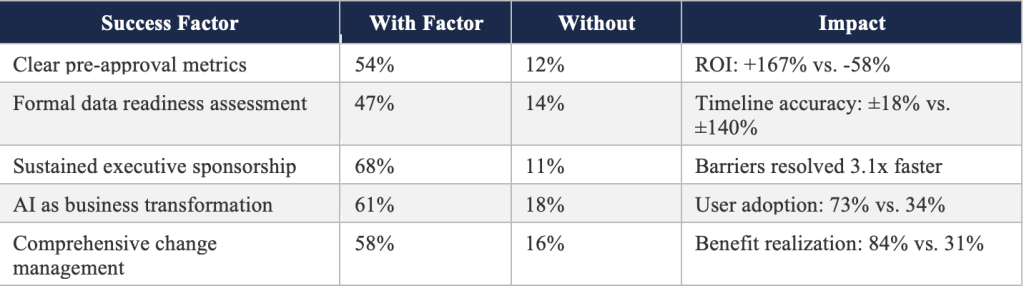
Source: Pertama Partners analysis of 2,400+ enterprise AI initiatives
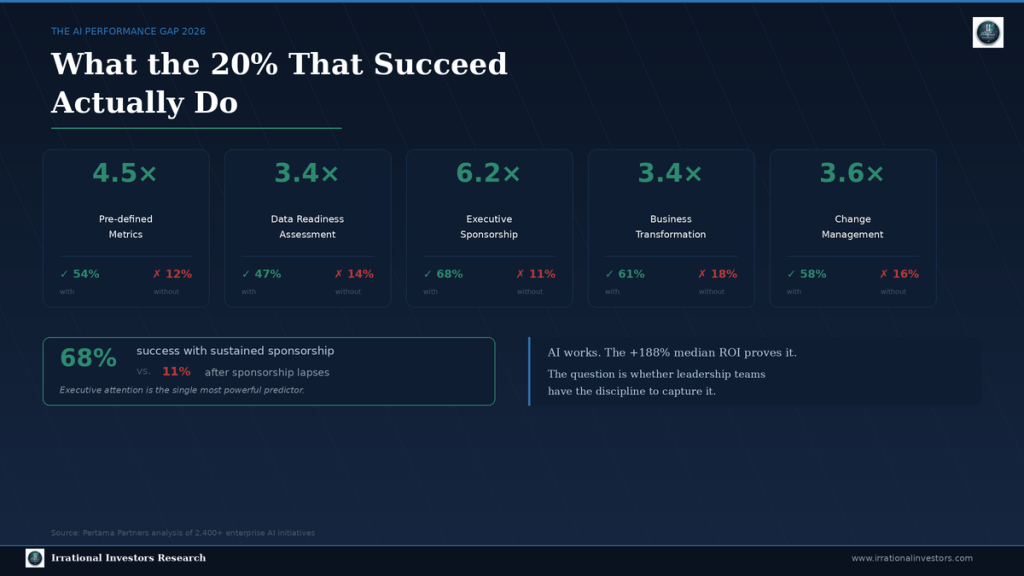
Sustained executive sponsorship is the single most powerful predictor, and produces a 68% success rate versus 11% when sponsorship lapses. Executive attention is the variable that separates capital creation from capital destruction.
The Real Question
During the last two years, the market has oscillated between AI euphoria and AI disillusionment, between trillion-dollar narratives about productivity revolutions and quarterly earnings calls where executives struggle to point to concrete returns. The data from the Pertama Partners analysis cuts through the noise with uncomfortable clarity.
AI WORKS. THE TECHNOLOGY IS NOT THE BOTTLENECK
The +188% median ROI for successful projects proves that the value creation potential is real and significant. But capturing that value requires something that no algorithm can provide: leadership discipline, honest self-assessment, sustained attention, and the willingness to invest in the unglamorous foundations, data quality, governance, and change management that determine whether an AI initiative creates value or destroys capital.
The organizations that get this right will compound their advantages. The ones that keep treating AI as a technology procurement exercise, launching pilots without metrics, losing executive interest after the initial announcement, and underinvesting in the human side of the equation, will keep feeding the 80% failure statistic.
The data is not ambiguous, the patterns are replicable, but the question is whether leadership teams have the discipline to follow them.
Just think about it and judge for yourselves.
References
- RAND Corporation (2025). Analysis of AI Project Outcomes across Enterprise Initiatives.
- MIT Sloan Management Review (2025). Generative AI Pilot-to-Production Scaling Study.
- McKinsey & Company. The State of AI in 2025.
- Deloitte (2025). Enterprise AI Adoption and Abandonment Survey.
- Gartner. AI Governance and Implementation Framework Analysis, 2025-2026.
- S&P Global Market Intelligence (2025). Enterprise AI Investment and Cost Survey.
- Pertama Partners (2026). AI Project Failure Statistics 2026: The Complete Picture. Published February 8, 2026, updated February 21, 2026.
Disclaimer
We wrote this article ourselves, and it reflects our own opinions. We did not receive compensation for it. We have no business relationship with any company mentioned in this article.
The views contained in this document are for informational and educational purposes only, and should not be construed as a recommendation to buy or sell any of the securities mentioned, or as a solicitation of transactions or clients. Past performance is not indicative of future results. Investments in equities carry risks, including loss of principal. Data cited herein is sourced from third-party research institutions and compiled by Pertama Partners. Irrational Investors makes no warranty as to the accuracy or completeness of third-party data. Readers should conduct their own due diligence before making any investment or strategic decisions. The information contained herein is believed to be appropriate; however, under no circumstances should any person act solely based on the information provided. We do not recommend that anyone act on any investment information without first consulting an investment advisor regarding the suitability of such investments for their specific situation.
Irrational Investors and/or its affiliates may hold a position in the securities mentioned in this report and may make purchases or sales of such securities from time to time in the open market or otherwise. The analyst primarily responsible for this report may also hold a personal position in the subject securities.
Descubre más desde Irrational Investors
Suscríbete y recibe las últimas entradas en tu correo electrónico.


