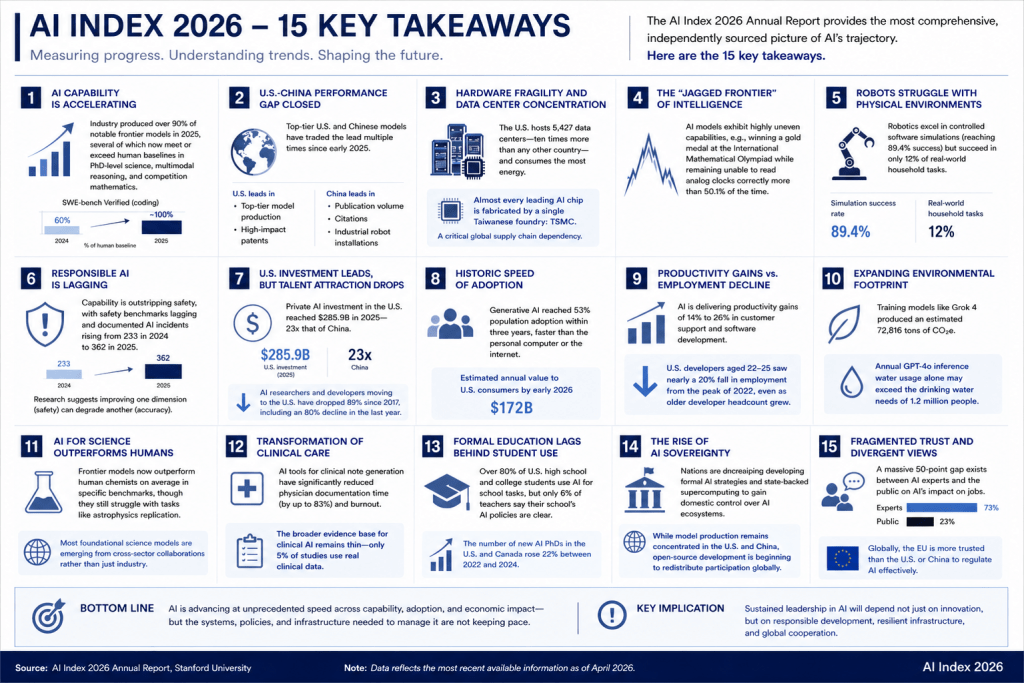
The 2026 AI Index Annual Report from Stanford University outlines a landscape in which AI capabilities are accelerating faster than the systems designed to evaluate, regulate, and support them. Given the fundamentally holistic nature of this transformation—far beyond a purely technological shift—this imbalance is deeply concerning and should be a primary focus for both corporate leaders and governments.
The report is rigorous, well-structured, and carefully footnoted (see the 15 top takeaways).
But it is also, in the ways that matter most right now, looking at the wrong thing.
Everything it measures (benchmarks, publications, disclosed models, public infrastructure) belongs to the visible layer of AI. The problem is that the visible layer seems to be no longer where the action is. The frontier where capabilities are advancing fastest is also the frontier where disclosure is lowest, benchmarks are least informative, and public datasets tell you the least about what is actually happening. The report captures the signal that can be captured. But is it the one that matters?
Today, the real story is about deployment, agentic workflows in production, proprietary data loops that never surface in a paper, and integrated systems for which no benchmark was designed to evaluate. These are not exceptions, they are increasingly the new normal. And they are not considered in the report, probably because they sit outside the boundaries of what can be measured or publicly verified.
As AI becomes more strategic, more proprietary, and more embedded inside organizations with no incentive to disclose what they have built, the share of progress that will be directly observable will shrink. The challenge is no longer just to measure how fast AI is advancing, but to recognize that an increasing share of that advancement may no longer be measurable at all.
Is the report (and many of us) tracking the race or just the dust it left behind?
Just take your time to think about it!
Disclaimer
We wrote this article ourselves, and it reflects our own opinions. We did not receive compensation for it. We have no business relationship with any company mentioned in this article.
The views contained in this document are for informational and educational purposes only, and should not be construed as a recommendation to buy or sell any of the securities mentioned, or as a solicitation of transactions or clients. Past performance is not indicative of future results. Investments in equities carry risks, including loss of principal. Data cited herein is sourced from third-party research institutions and compiled by Pertama Partners. Irrational Investors makes no warranty as to the accuracy or completeness of third-party data. Readers should conduct their own due diligence before making any investment or strategic decisions. The information contained herein is believed to be appropriate; however, under no circumstances should any person act solely based on the information provided. We do not recommend that anyone act on any investment information without first consulting an investment advisor regarding the suitability of such investments for their specific situation.
Irrational Investors and/or its affiliates may hold a position in the securities mentioned in this report and may make purchases or sales of such securities from time to time in the open market or otherwise. The analyst primarily responsible for this report may also hold a personal position in the subject securities.
Descubre más desde Irrational Investors
Suscríbete y recibe las últimas entradas en tu correo electrónico.


